
How to Read The Odyssey: A Beginner's Guide to Books I~XXIV
Learn how hard The Odyssey is, how long Lita Book's Bryant edition takes, and how to finish Books I~XXIV with a practical 14 day plan.
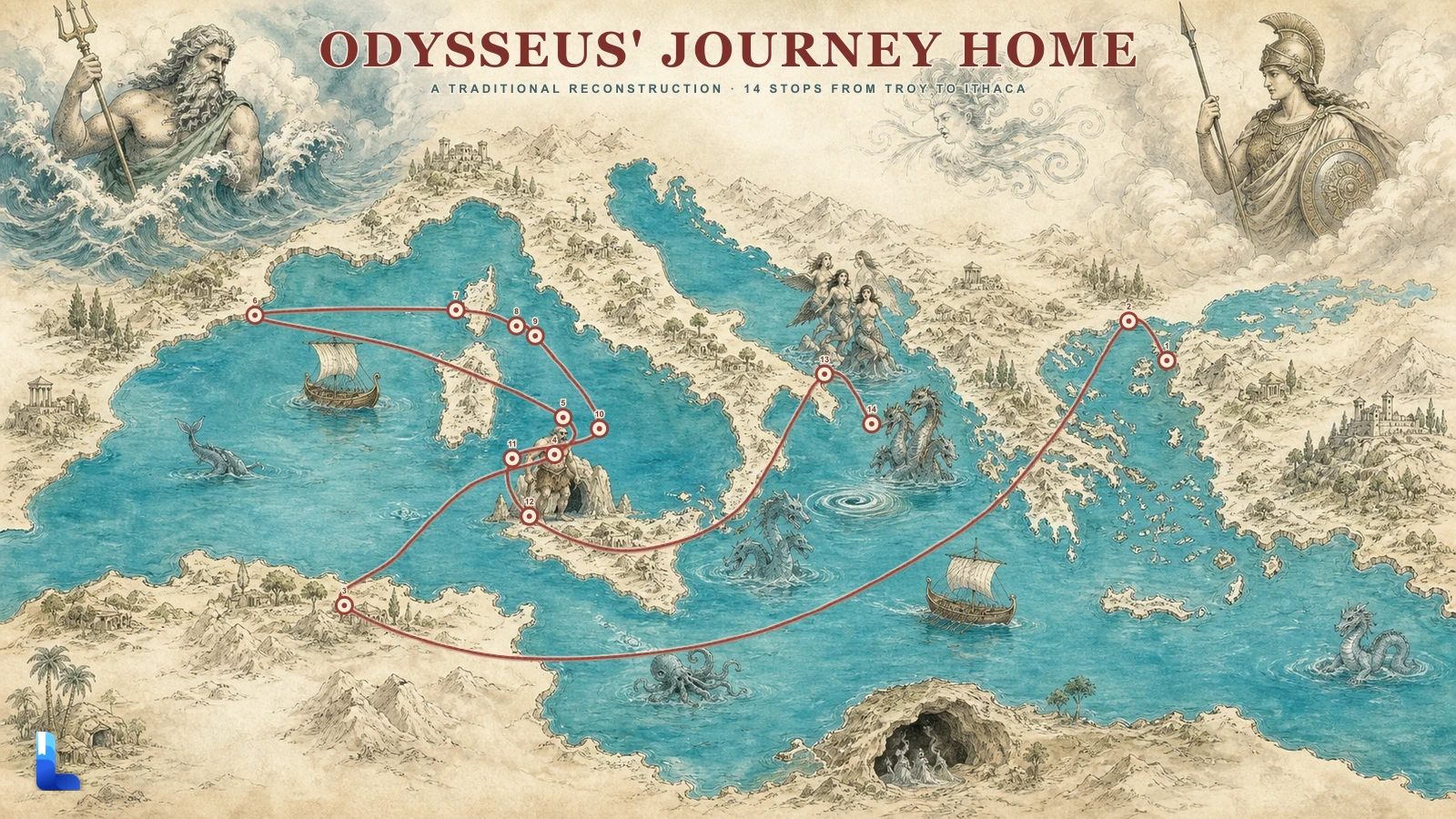
The Odyssey is moderately difficult, but the story is much easier than its age suggests. The main obstacles are entering a plot that starts near the end, recognizing names that change between translations, and understanding how its 24 internal books fit together. Lita Book’s William Cullen Bryant edition contains 120,067 words and is estimated at 442 minutes. A comfortable first reading takes about 8~10 hours, or roughly 35~45 minutes a day for two weeks.
You do not need to read The Iliad first. You need a map of the poem’s structure and permission not to memorize every name.
How long does The Odyssey take to read?
The answer depends on the translation. One version may use short modern verse, another may use long lines of blank verse, and another may use prose. Page counts also change with the introduction, notes, type size, and line breaks.
This guide uses the William Cullen Bryant translation distributed in Lita Book. It is one complete book in the app, with a preface and 24 internal divisions labeled Book I through Book XXIV. The Lita database records 120,067 words and an estimated reading time of 442 minutes, or 7 hours 22 minutes, at the app’s faster pace. At 250 words per minute, the text takes almost exactly 8 hours. At 200 words per minute, it takes about 10. Notes, rereading, and unfamiliar names may add another hour or two on a first visit.
Over 14 days, that works out to:
At 250 words per minute, the daily average is about 34 minutes. At 200 words per minute, it is about 43 minutes. Most days cover one or two of the poem’s internal books.
That is substantial, but it should not take a semester. The poem becomes quicker once Odysseus begins telling his own adventures in Book 9. The final books tighten when he enters the palace in disguise and prepares to confront the suitors.
Is The Odyssey hard to read?
The plot of The Odyssey is easier than its form. A man is trying to get home after a war. His wife and son are trapped with men consuming his estate. Gods help some people and block others. They also hide identities and put mortals through tests. The monsters are memorable, and the characters’ motives are usually clear.
Four things make a first reading feel harder.
First, the poem does not begin with the Cyclops or even with Odysseus. Books 1~4 follow Telemachus, the son who barely remembers his father. Odysseus appears in Book 5. His most famous wanderings arrive later still, as stories he tells about his past in Books 9~12. If you expect a straight journey from Troy to Ithaca, the opening can feel like the wrong book.
Second, names change between translations. Odysseus may be called Ulysses. Zeus may be Jove or Jupiter. Poseidon may be Neptune. Bryant uses many Roman forms, but they are not extra characters. Keep this small key nearby:
| Bryant’s name | Common Greek name | Role |
|---|---|---|
| Ulysses | Odysseus | King of Ithaca, trying to return home |
| Jove | Zeus | Ruler of the gods |
| Neptune | Poseidon | Sea god and Odysseus’s enemy |
| Minerva | Athena | Odysseus’s divine ally |
| Mercury | Hermes | Messenger of the gods |
Third, repeated phrases can look strange on the page. Dawn often returns with the same description. Meals follow familiar steps, and hosts welcome visitors before asking questions. These patterns helped listeners follow a poem that was performed aloud. Let them guide you instead of treating them as unnecessary repetition.
Finally, the poem comes from a moral world very different from ours. Hospitality is sacred, fame can outlive the body, and slavery is treated as normal. Odysseus can be clever and loving, but he can also lie, act with pride, and use terrible violence. Athena still favors him. The poem becomes harder if you try to decide whether he is simply “good.” It is better to watch what he does and decide how you feel about each choice.
Choose the translation that keeps you reading
Every English Odyssey makes choices. A translation decides how fast the story moves, how formal the speakers sound, which repeated phrases remain, and how close Odysseus feels to the reader.
The Bryant translation in Lita Book is complete and written in blank verse. This means the lines follow a poetic rhythm but do not rhyme. The language is old fashioned, and Bryant often uses Roman names. Choose it if you enjoy poetry from the nineteenth century and want to stay with one edition.
If Bryant’s first two pages feel like a wall, try another translation before blaming the poem. A modern verse translation usually reads faster. A prose translation may make the order of events easier to follow. Compare the opening or the Cyclops scene in two versions, then choose the voice that makes you want to keep reading.
Do not spend a week trying to identify the academically “correct” version. Every translation interprets Homer’s Greek. The useful first translation is the one you will finish.
See the three stories inside the poem
The simplest map of The Odyssey has three movements.
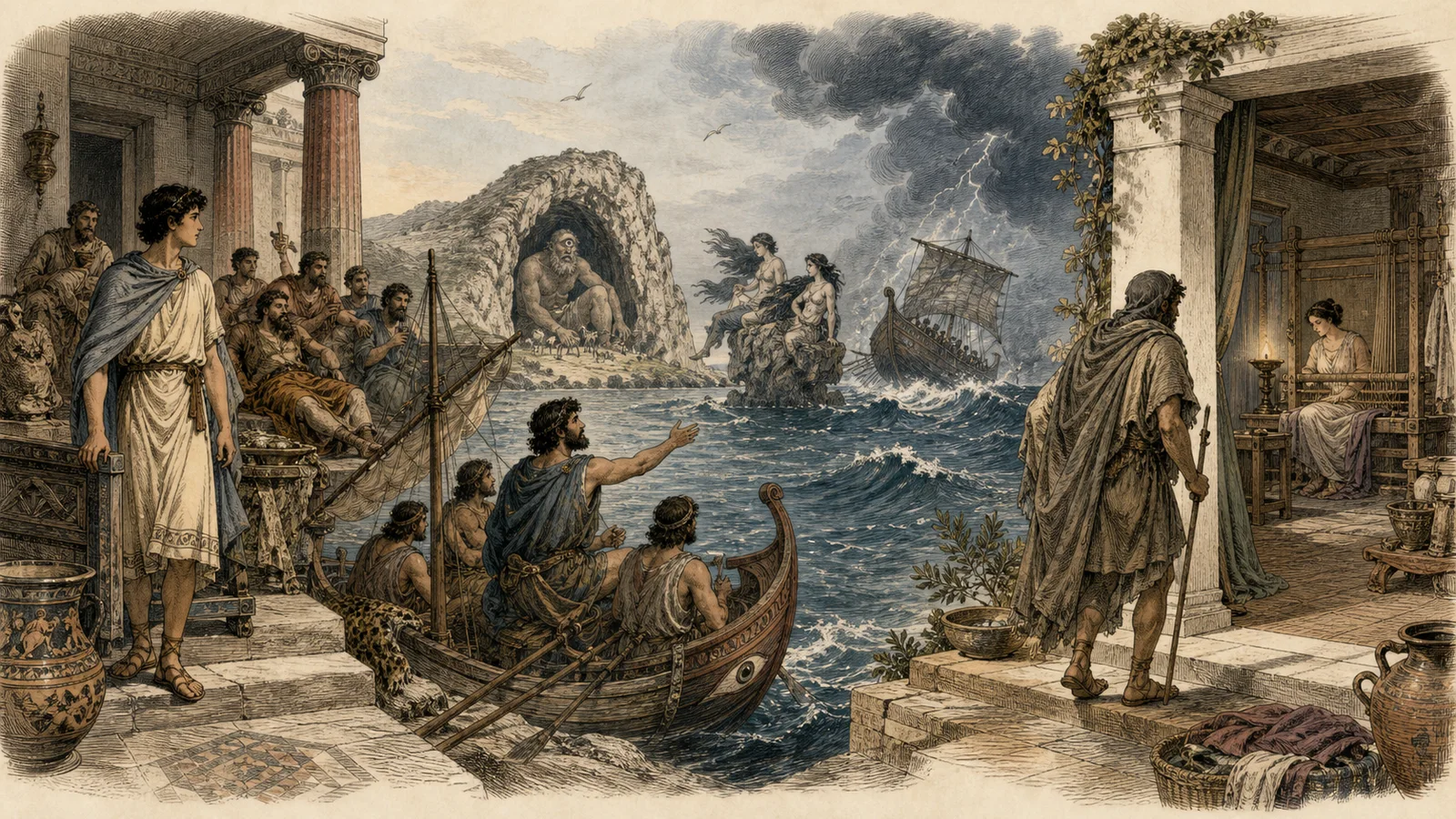
Books 1~4: the son searches for the father
Telemachus lives in a house that no longer obeys him. The suitors court Penelope, consume the household’s food and wine, and treat Odysseus’s absence as permission to seize his place. Athena pushes Telemachus to speak publicly and travel for news.
These books are sometimes called the Telemachy. Do not treat them as a delay before Odysseus appears. They show what has happened to his home. The suitors are draining the household and trying to take his place. These books also teach the poem’s main rule of hospitality. A good host feeds a stranger before asking who he is. A bad guest takes until the house breaks.
Books 5~12: the wanderer becomes his own storyteller
The gods arrange Odysseus’s release from Calypso. He reaches the Phaeacians, where he finally tells the adventures most readers already know: the Cicones, Lotus Eaters, Cyclops, Aeolus, Laestrygonians, Circe, the dead, Sirens, Scylla and Charybdis, and the cattle of the Sun.
Odysseus tells much of the adventure himself. The poem’s best liar is also the source of its most famous stories. You do not have to assume that every detail is false. Pay attention to how he describes disasters, including the ones made worse by his own choices. His story wins sympathy and helps him get home.
Books 13~24: home becomes the most dangerous island
Odysseus reaches Ithaca halfway through the poem, not at its final page. Athena disguises him. He tests servants, allies, son, and wife while learning what happened in his absence. The pace narrows from a sea full of monsters to rooms, thresholds, glances, scars, a bow, and a bed.
This long return is the reason to keep reading after the famous monsters. Surviving the Cyclops is only part of the problem. Odysseus has been away for twenty years, and the people at home must decide whether they recognize the man who returns. The poem also asks whether killing the suitors can truly bring peace back to Ithaca.
A 14 day plan that follows the journey
This plan follows Books I~XXIV in the Lita Book Bryant edition. They are sections within one volume, not 24 separate books to buy or download. Some early travel sections are grouped together to keep the journey moving. The bow contest, the killing of the suitors, and the final reunions receive separate days so you do not have to rush the ending.
- Books 1~2 · about 32 minutes. Meet Telemachus, Penelope, Athena, and the suitors. Track who respects the rules of host and guest.
- Book 3 · about 19 minutes. Telemachus visits Nestor at Pylos. You do not need to remember every veteran's route home. Notice how the sons are left with stories and problems from their fathers' war.
- Book 4 · about 31 minutes. Menelaus and Helen remember Troy while the suitors plan an ambush. This is the longest book in the edition, so let it stand alone.
- Books 5~7 · about 42 minutes. Odysseus leaves Calypso, survives the sea, meets Nausicaa, and enters the Phaeacian court as an unnamed stranger.
- Books 8~9 · about 41 minutes. Songs about Troy force Odysseus to reveal himself. His own account begins with raids, forgetfulness, and the Cyclops. Watch where cleverness turns into pride.
- Books 10~11 · about 44 minutes. The bag of winds, Laestrygonians, and Circe lead toward the land of the dead. Read the encounters with Elpenor, Tiresias, and Odysseus's mother slowly.
- Books 12~13 · about 34 minutes. The Sirens, Scylla and Charybdis, and the cattle of the Sun end the voyage narrative. Odysseus finally reaches Ithaca but fails to recognize it.
- Books 14~15 · about 40 minutes. Odysseus tests the swineherd Eumaeus while Telemachus starts home. Pay attention to the life stories people tell. In this part of the poem, a person's story often shapes how others see them.
- Books 16~17 · about 39 minutes. Father and son recognize each other and begin their plan. The disguised king enters his own palace and receives its judgment from the doorway.
- Books 18~19 · about 38 minutes. The beggar fights, Penelope appears before the suitors, and the nurse Eurycleia recognizes a scar. Odysseus's lies now protect rather than entertain him.
- Book 20 · about 14 minutes. A short day of omens and restraint. Ask who can see that the household is about to change.
- Books 21~22 · about 34 minutes. Penelope sets the bow contest. Read the stringing of the bow and the killing of the suitors together as one sequence.
- Book 23 · about 14 minutes. Penelope does not accept a returned husband merely because he claims the name. Her test of the marriage bed is the poem's most important recognition.
- Book 24 · about 20 minutes. The dead suitors reach the underworld, Odysseus meets Laertes, and Athena stops the next cycle of revenge. Decide whether the ending feels peaceful or imposed.
The minute estimates divide Lita Book’s total of 442 minutes according to the length of each day’s reading. Treat them as planning numbers, not promises. Book 11 may take longer if you pause over the dead, while the action in Books 21~22 may move faster.
If you miss a day, do not double the next one automatically. Move the schedule forward. Keeping the story fresh in your mind matters more than finishing on the exact date you first chose.
Read for recognition, hospitality, and stories
Three questions will carry you through almost every scene.
Who recognizes whom? Athena changes people’s appearances. Odysseus hides his name. Telemachus has never known his father as an adult, and Penelope has lived with rumors for years. A face is rarely enough. A scar, a shared secret, an action, or a piece of furniture may provide stronger proof.
Who is acting as host, and who as guest? The Cyclops and the suitors are connected before they ever share a plot. Both violate hospitality. The Phaeacians offer its ideal form. Once you see this pattern, many episodes that looked like unrelated adventures become variations on one social test.
Who controls the story? Bards sing about Troy. Helen, Menelaus, Nestor, Eumaeus, and Odysseus tell the past differently. Penelope invents delays. Odysseus survives by naming, disguising, and revising himself. The poem admires storytelling while repeatedly asking what a beautiful story conceals.
Do not turn those questions into homework after every page. Use them when the names blur or the journey seems to pause. They will usually show what the scene is doing.
What to know before the new movie
Christopher Nolan’s 2026 film preserves the premise of a warrior trying to return to Ithaca. Its scale draws attention to Troy, monsters, and physical survival. Homer’s poem spends far more time on Telemachus, hospitality, storytelling, disguise, and the slow work of recognition.
Reading first will not ruin the movie. The plot has lasted for nearly three thousand years because each version tells it differently. The poem will help you notice more than which islands Nolan removes. You will also see how he changes Odysseus when the gods step back, his clever stories matter less, and some of his most troubling choices disappear.
For the comparison with full spoilers, continue with Christopher Nolan’s The Odyssey vs. Homer: how the film rewrites Odysseus.
You can read Bryant’s complete translation through Standard Ebooks or in Lita Book’s classic collection. The figures for reading time and structure in this guide come from the actual Lita Book edition: book ID 1727, 120,067 words, 442 estimated minutes, and Books I~XXIV. Start with the structure, not the footnotes. The story moves faster once Odysseus begins speaking for himself.