
12 Books Like Pride and Prejudice You Can Read for Free
Loved Pride and Prejudice? These twelve free classics carry on its wit, romantic misjudgments, difficult families, and sharp social observation.
After Pride and Prejudice, another romance may not be enough. You may also want sharp dialogue, money problems that affect courtship, families that make privacy impossible, and a character who learns that a confident opinion can still be wrong.
These twelve books keep one or more of those pleasures alive. Every title can be read free online, and all twelve are included in Lita Book’s free collection of timeless classics. They are arranged by mood rather than by a claim that any novel can reproduce Elizabeth Bennet and Mr Darcy.
If you have not finished Austen’s novel yet, start with our Pride and Prejudice reading guide. Otherwise, stay in the drawing room.
Start with the part you miss most
If you liked watching Elizabeth trust her own judgment too much, read Emma. For a second chance after years apart, choose Persuasion. Northanger Abbey comes closest to the playful arguments between Elizabeth and Darcy. Wives and Daughters gives you a whole town to know. The Tenant of Wildfell Hall and The Age of Innocence show how badly social judgment can hurt when the story is not a comedy.
Every book here is free to read and available in Lita Book. Each one also shares something specific with Pride and Prejudice. It may have courtship through conversation, money affecting marriage, a heroine who changes her mind, or a family that makes private choices public.
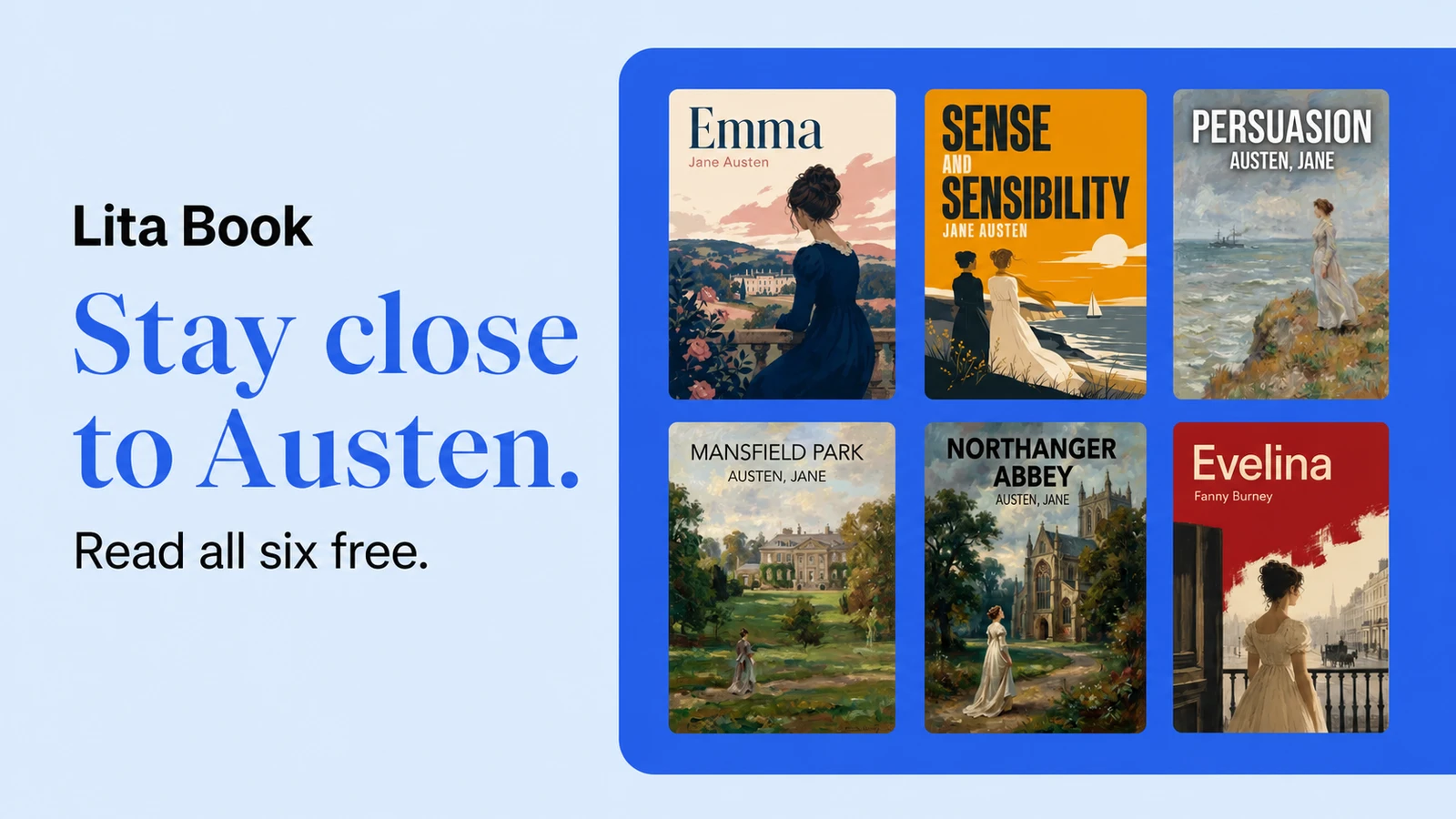
Stay for Austen’s voice
The closest book to Pride and Prejudice depends on what you loved in it. If you loved Austen’s voice, start with another Austen novel. She does not repeat Elizabeth and Darcy. Each heroine makes a different kind of mistake, and each romance faces a different problem.
1. Emma
Read Emma free if Elizabeth’s confidence was as important to you as the romance. Emma Woodhouse is clever, wealthy, and almost completely protected from consequences. That freedom lets her arrange other people’s lives as if the village were a story written for her amusement.
The pleasure comes from seeing further than Emma while still enjoying her company. Mr Knightley challenges her, but the most painful corrections arrive when Emma recognizes what her games have cost someone with less money and less social protection. It is funnier and more uncomfortable than a simple matchmaking comedy.
2. Sense and Sensibility
In Sense and Sensibility, two sisters meet the same economic problem with opposite temperaments. Elinor controls what she shows. Marianne treats concealment as a kind of dishonesty. Neither method saves them from men whose choices are shaped by inheritance, family pressure, and cowardice.
Read it for the Bennet family part of Pride and Prejudice: sisters comparing what they know at night, a mother making a bad situation louder, and marriage shaped by both love and money. The romance takes time because Austen shows how much effort Elinor spends hiding what she feels.
3. Persuasion
Persuasion begins where a younger Austen heroine’s story might have ended badly. Anne Elliot was persuaded to reject Frederick Wentworth eight years earlier. When he returns with money and professional success, she cannot undo the decision or demand another chance.
Persuasion is quieter than Pride and Prejudice. The rooms are still full of vanity and people judging one another, but Anne often watches from the edge. If you liked seeing Darcy prove that he had changed at Pemberley, Persuasion builds a whole romance around the same idea. Love has to appear in attention, memory, and action.
4. Mansfield Park
Mansfield Park is the difficult Austen recommendation. Fanny Price has little of Elizabeth’s social ease. She arrives at Mansfield as a poor relation and learns to survive by observing everyone who has the power to send her away.
The house becomes more exciting when the Crawford siblings arrive, but charm does not make them good people. The novel asks what happens when saying no comes at a cost. Readers often disagree with Fanny. That makes the book a good next choice for anyone interested in how Austen separates confidence from good judgment.
Keep the wit and change the room
Austen did not invent young women entering rooms where everyone else seems to know the rules. She did, however, make that situation unusually exact. These four books move the comedy into Bath, London, Florence, and an Italian castle, where a mistake in reading the room can become the whole plot.
5. Northanger Abbey
Northanger Abbey is the shortest and most openly playful choice here. Catherine Morland has read enough Gothic fiction to expect locked rooms, terrible secrets, and villainous fathers. Ordinary Bath society turns out to be dangerous in less theatrical ways.
Henry Tilney is one of Austen’s best conversational partners because he hears the assumptions inside Catherine’s sentences. Their attraction grows through teasing, embarrassment, and correction. Choose this next if the verbal rhythm of Elizabeth and Darcy mattered more than the grandeur of Pemberley.
6. Evelina
Frances Burney published Evelina in 1778, before Austen’s major novels. Its heroine enters fashionable society without secure status or much experience, then tries to interpret a series of humiliating public encounters through letters.
The comedy is broader than Austen’s and sometimes more chaotic. Men corner Evelina, relatives embarrass her, and small rules decide who is allowed to feel comfortable in public. The book has many elements that Austen later used in her own way. A young woman tries to judge people correctly while manners and social rank shape every courtship.

7. A Room with a View
E. M. Forster’s A Room with a View trades Regency drawing rooms for English tourists in Florence, but it understands the comedy of a group using manners to prevent honesty. Lucy Honeychurch is promised a view, receives the wrong room, and meets people who unsettle the careful life waiting for her at home.
George Emerson lacks Darcy’s polished self control, while Cecil Vyse has too much of it. Lucy must learn the difference between good manners and real closeness. The book is quick and funny. It is especially good at showing how a respectable future can begin to feel like a trap.
8. The Enchanted April
In The Enchanted April, four English women rent an Italian castle after answering a newspaper advertisement. Two are trapped in dull marriages, one is a beautiful aristocrat exhausted by attention, and one prefers solitude to almost everyone.
The Italian setting changes how the four women see their lives, much as Pemberley changes how Elizabeth sees Darcy. The novel is warmer and less sharp than Austen. It still asks what people do when they leave the homes and social rules that shaped them. Read it when you want reconciliation and the comedy of houseguests who do not get along.
Let the choices become more expensive
The last four novels keep the courtship plot and raise its price. Reputation can determine whether a woman keeps her child. An engagement can harden into a whole social identity. Escape may require leaving a family that has already decided who you are.
9. Wives and Daughters
Elizabeth Gaskell’s Wives and Daughters is the longest book on this list and one of the easiest to inhabit. Molly Gibson’s quiet life changes when her widowed father remarries. Her new stepsister Cynthia attracts devotion almost without trying, while Molly becomes the person trusted with everyone else’s secrets.
Gaskell observes a small town as carefully as Austen does, but her story spreads across more households and becomes messier. Science, wealthy patrons, gossip, and family loyalty all affect the romance. Gaskell died before writing the final section, but it is clear how she meant the relationships to end. The book does not feel as unfinished as that fact might suggest.
10. The Tenant of Wildfell Hall
The Tenant of Wildfell Hall begins with a community deciding what kind of woman Helen Graham must be. She lives alone, supports herself by painting, protects her son, and refuses to satisfy the village’s curiosity. Gilbert Markham is drawn to her, then behaves badly when his preferred explanation begins to fail.
Anne Brontë pushes beyond Austen’s marriage plot by asking what happens after a charming choice becomes a dangerous husband. The book is harsher, but its central demand is familiar: affection has no value without the discipline to see another person clearly.
11. The Age of Innocence
Edith Wharton’s The Age of Innocence moves the marriage market to 1870s New York. Newland Archer believes he understands the rules because they were designed for men like him. The arrival of Ellen Olenska exposes how little freedom those rules permit, even to people who appear to benefit from them.
Wharton writes social ritual with a colder edge than Austen. A dinner invitation can punish, an opera box can announce allegiance, and silence can close a life. Read this when the entail, Lady Catherine, and the invisible force of respectable opinion interested you more than the happy ending.
12. The Blue Castle
L. M. Montgomery’s The Blue Castle gives its heroine a freedom that begins with frightening news. Valancy Stirling has spent 29 years obeying a family that treats her as a disappointment. Believing her time is short, she stops asking permission.
The book is more openly romantic than Austen and far kinder to fantasy. Still, Valancy’s escape depends on learning how much of her personality was built to avoid ridicule. If Elizabeth’s refusal of Mr Collins made you want an entire novel about a woman declining the life selected for her, end here.
All twelve titles can be opened free in Lita Book, alongside thousands of other classics. Choose the part of Pride and Prejudice that you miss most. A country house alone will not recreate Austen. The sharp conversations, money worries, family demands, and mistaken judgments are what matter.