
Christopher Nolan's The Odyssey vs. Homer: How the Film Rewrites Odysseus
A full spoiler comparison of Nolan's The Odyssey and Homer, showing how changes to Troy, the gods, storytelling, and the ending remake Odysseus.
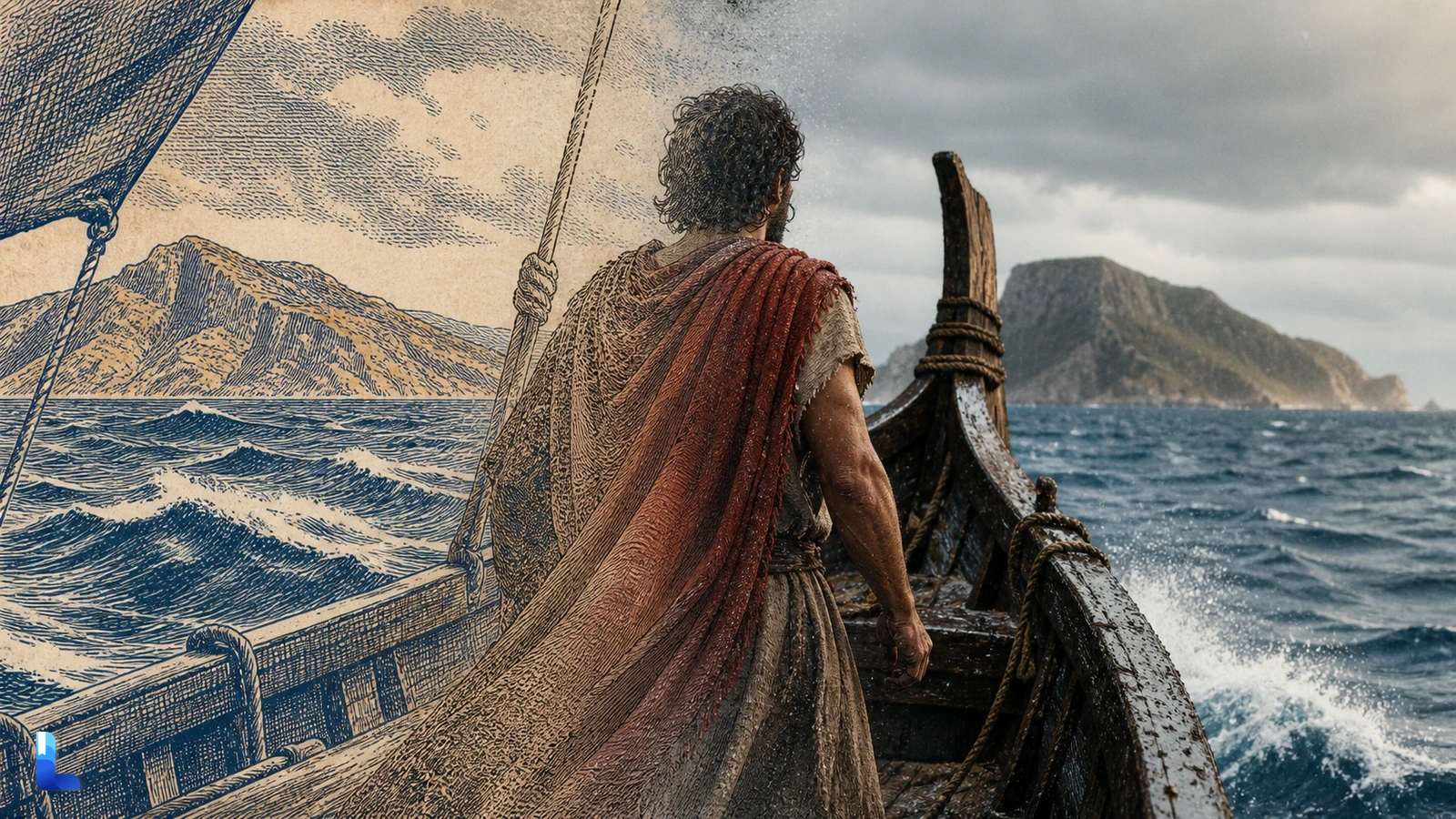
Christopher Nolan’s The Odyssey keeps the destination but changes the man traveling toward it. Homer’s Odysseus is a divinely favored trickster who survives by controlling stories. Matt Damon’s Odysseus is a leader damaged by war and forced to confront what his cleverness has cost. Most of the film’s major changes, from the quieter gods to the new ending, follow from that decision.
Full spoilers follow for the 2026 film and Homer’s poem. If you want to read first, use our beginner’s guide to Books I~XXIV.
The short version: same journey, different hero
The film is broadly faithful to the shape everyone remembers. Odysseus struggles home from Troy. Penelope holds off the suitors. Telemachus searches for his father. The Cyclops, Circe, Calypso, Sirens, Scylla and Charybdis, the dead, the bow, and the return to Ithaca all remain recognizable.
The film focuses on a different side of Odysseus. Homer takes pleasure in his clever lies. Odysseus lies to enemies, hosts, servants, his wife, and even his father. Athena loves him partly because he is as clever as she is. Nolan keeps that intelligence but treats his lies as part of the damage caused by war. His Odysseus cannot stop thinking about the Trojan Horse.
This change affects the whole film. It changes why Odysseus leaves Calypso, what the Cyclops episode shows, how directly the gods take part, and what it means for him to come home.
Troy becomes the cause, not just the backstory
Homer begins after Troy has fallen. We hear about the war through songs and memories. Helen and Menelaus tell Telemachus stories, the bard Demodocus sings at the Phaeacian court, and Odysseus cries when he hears a song about his own past. The wooden horse appears as a memory, not as part of an opening battle sequence.
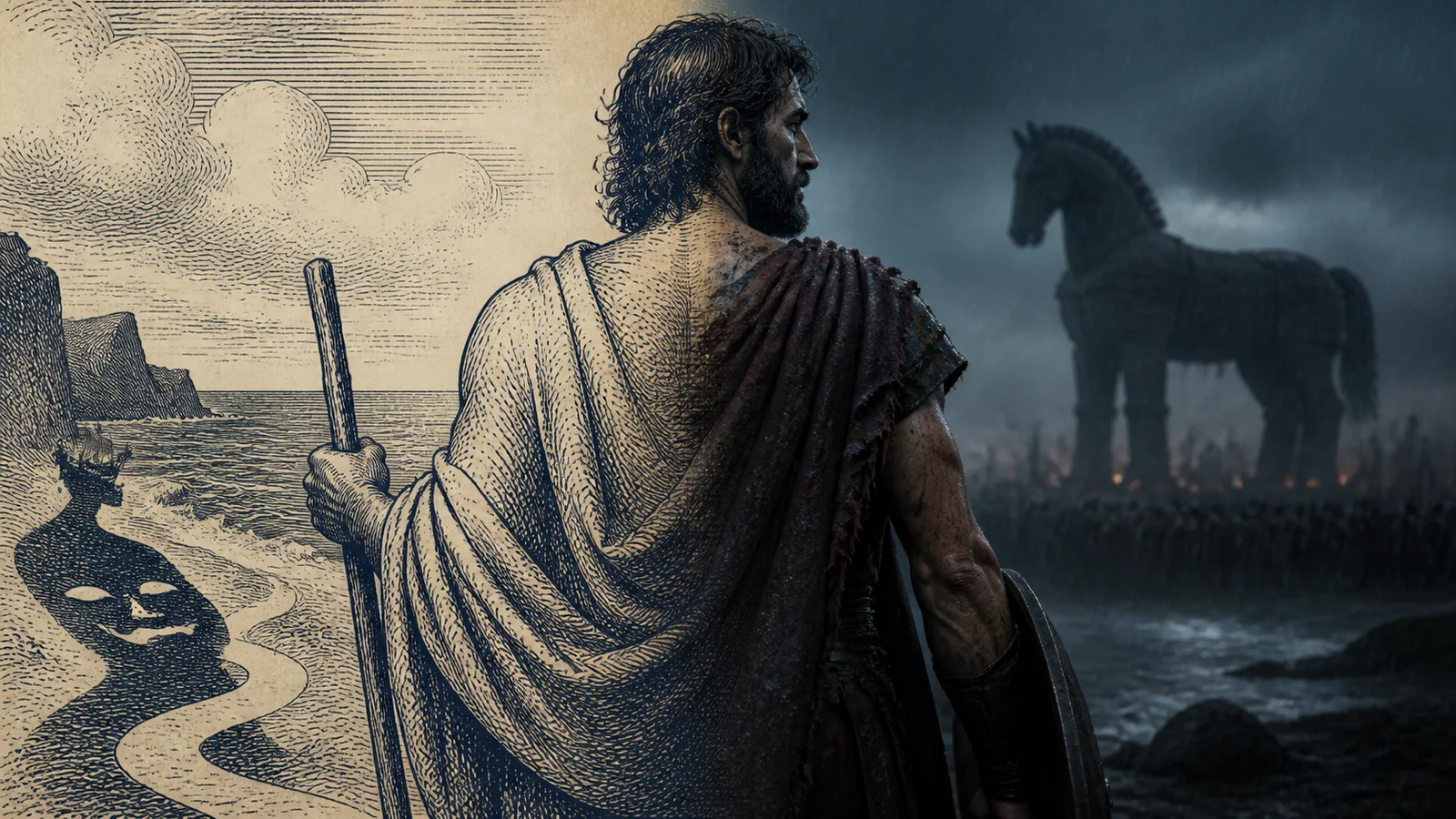
Nolan shows the horse and the fall of Troy directly. Odysseus sees it as both his greatest trick and a terrible act. The memory follows him throughout the film. His journey home becomes a struggle with what the war has done to him.
The film returns to Troy to explain why Odysseus cannot settle at home. Homer handles the war differently. Several characters tell their own stories about it, and those stories mix grief, pride, and uncertain memories.
The film also borrows beyond Homer. Sinon, linked to the horse in Virgil’s Aeneid, does not appear in The Odyssey. Nolan folds that later tradition into his adaptation and invents a connection between Sinon and the suitor Antinous. The result draws on the larger mythic tradition, not only Books I~XXIV of Homer’s poem.
The “complicated man” becomes a traumatized one
Homer’s Odysseus is polytropos, a man of many turns who can adapt to almost anything. He invents identities under pressure and sometimes when the danger has already passed. In the Cyclops cave, the false name “Nobody” saves his men. Minutes later, vanity makes him shout his real identity back across the water, allowing Polyphemus to call on Poseidon for revenge.
Both sides belong to the same character. Odysseus’s intelligence saves him, but his pride and desires also make the journey longer. Homer does not try to make those qualities fit into one simple explanation.
Nolan replaces much of that pleasure in quick thinking with regret. His Odysseus takes less pleasure in tricking people and feels more troubled by the violence his tricks cause. This change has divided readers. In an Associated Press interview, Daniel Mendelsohn argues that the film has removed Odysseus’s wit and charm. Graphic novelist Gareth Hinds asks how much the hero can change before the story also becomes something different.
The film explains Odysseus through guilt, painful memories, and the effects of war. That is easy for a modern audience to understand. But it loses something strange and enjoyable from Homer. The Odysseus of the poem tells stories to survive, and he also seems to enjoy inventing them.
The gods withdraw from the room
The first major scene in Homer’s poem is a meeting of the gods. Athena argues for Odysseus and visits Telemachus in disguise. She changes how people look, brings them together, and finally stops more bloodshed on Ithaca. Poseidon is not simply a symbol for bad weather. He is a father punishing the man who blinded his son. The gods act directly alongside the human characters.
Nolan keeps most of the gods off screen. Athena is the only Olympian shown, and Odysseus sees her in a vision. Zeus and Poseidon never appear. Athena also gives far less direct help than she does in the poem.
This puts more responsibility on the human characters. In the poem, a disaster may come from fate, a god, or a person’s reckless choice. The film may still let characters see religious meaning in storms and strange events, but it focuses on the results of human decisions.
Telemachus changes too. In the poem, Athena repeatedly guides him while wearing different disguises. The film gives him much less direct help from the gods. He has to respond on his own to political danger and an absent father.
The Cyclops loses the joke and reveals the adaptation’s method
Homer’s Polyphemus episode is horrific, but it is also a verbal contest. Odysseus brings strong wine, calls himself Nobody, blinds the drunken Cyclops, and escapes beneath the bellies of sheep. When Polyphemus cries that “Nobody” is hurting him, the other Cyclopes leave him alone. The hero wins by turning grammar into a weapon, then nearly ruins the victory by announcing his name.
The film keeps the cave, the blinding, and an escape disguised among sheep, but strips away most of the linguistic game. Its Cyclops is less conversational and more immediately monstrous. The wine and Nobody ruse disappear, and the mechanics of the escape change.
The Cyclops scene shows how Nolan changes the poem. Homer lets Odysseus win through language, then nearly lose everything because he proudly reveals his name. The film turns the episode into a more direct fight for survival. Odysseus’s clever words no longer show both his greatest strength and his greatest weakness. Nolan moves that conflict to the larger story about the Trojan Horse and the guilt that follows it.
The voyage is shorter, and Odysseus tells less of it
The monsters occupy less of Homer’s poem than cultural memory suggests. Books 1~4 belong to Telemachus. Odysseus tells most of his famous adventures in Books 9~12 while being hosted by the Phaeacians. By Book 13 he is already on Ithaca, where the poem remains for its final half.
The Phaeacian section matters because Odysseus needs these people to give him a ship. He tells them his adventures, but he is also trying to win their trust and help. They listen to his stories along with us.
Nolan removes the Phaeacians and shortens or removes parts of the route. Aeolus’s bag of winds is gone. Other threats are combined or changed. The movie still moves between the journey, Troy, and Odysseus’s memories, but Odysseus no longer narrates most of the voyage himself.
This keeps the movie moving instead of stopping for several books of narrated memories. But it also removes an important idea from Homer. We know Odysseus mainly through the story that he chooses to tell his hosts.
Circe and Calypso become tests of memory and fidelity
Homer’s episodes with Circe and Calypso can make modern readers uncomfortable. Circe transforms the crew, then becomes Odysseus’s lover after he defeats her magic. She hosts the men for a year and later helps them. Calypso keeps Odysseus for seven years and offers him immortality. He wants to go home, but he leaves only after Hermes brings an order from Zeus.
Nolan shortens and darkens Circe’s episode. There is no yearlong recovery or sexual relationship, and the transformation of the crew becomes body horror. Calypso uses lotus flowers to blur Odysseus’s pain and memory. His departure becomes a recovery of the desire to return rather than the result of an order passed down from Zeus.
Both changes keep the film’s Odysseus more focused on Penelope. Circe and Calypso now represent his struggle with painful memories and the temptation to forget. Homer gives them more complicated roles. The poem does not treat returning home and remaining sexually faithful as the same thing. It also shows an unequal balance of power between a mortal man and goddesses who can threaten him, hold him, desire him, and help him.
Nolan gains a cleaner marriage story. Homer preserves a stranger one.
Homecoming no longer restores the old order
Both versions move toward the bow and the killing of the suitors, but recognition works differently around the violence. In Homer, Odysseus and Telemachus reunite privately in Eumaeus’s hut and plan together. Nolan turns their meeting into an invented action sequence before Telemachus knows the beggar fighting beside him is his father.
Penelope then gives Odysseus a private test. She orders their marriage bed moved. Odysseus protests because he built it around a living olive tree. Only the real Odysseus would know that the bed cannot move. This shared secret proves his identity.
The poem does not end at that reunion. Odysseus meets his father Laertes, and the suitors’ families prepare to take revenge. Athena stops the fighting. The peace feels forced, but it prevents more bloodshed on Ithaca.
Nolan chooses another departure. Telemachus becomes king while Odysseus and Penelope sail away to honor his fallen comrades. Nolan has said that he excluded parts of the poem’s ending because he found them grim and misogynistic, while retaining its questions about men and war. The warrior reaches home only to accept that return cannot mean resuming the life interrupted twenty years earlier.
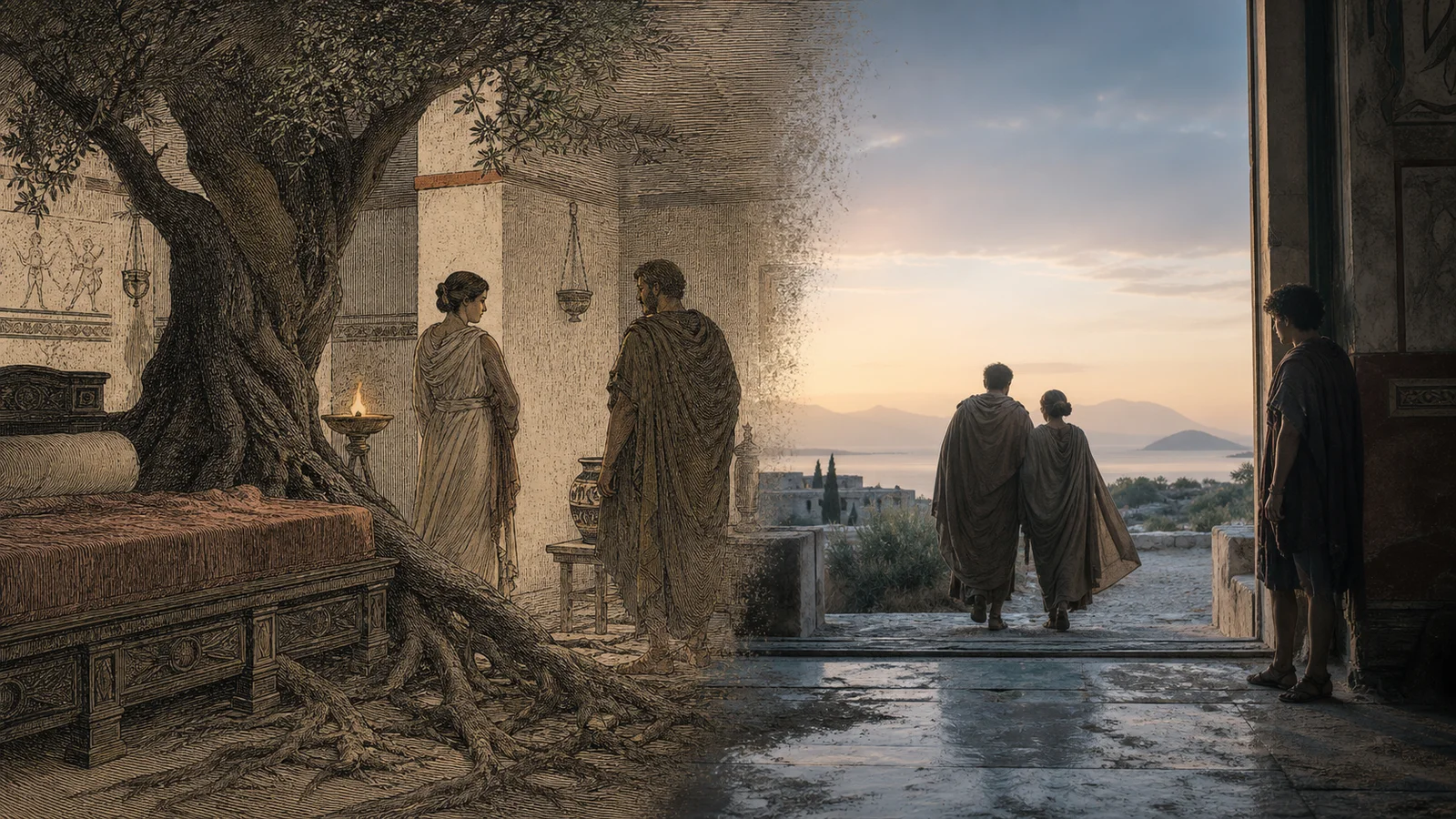
The two endings make different points. Homer’s bed proves that Odysseus and Penelope still share a private history after twenty years apart. Nolan sends them away from Ithaca together. In the film, their marriage may survive, but Odysseus cannot simply return to his old life as king.
Is Nolan’s Odyssey faithful to Homer?
The film follows the broad journey but changes how the poem treats the gods, violence, and responsibility. Calling it simply accurate or inaccurate misses that larger change.
Nolan keeps the return to Ithaca, the memories of Troy, the family conflict, most of the famous dangers, the disguise, the bow, and the killing of the suitors. But his Odysseus is interesting for different reasons. The gods matter less, and his clever lies have a smaller role. Guilt, the effects of war, and the fall of Troy become more important. The new ending also makes clear that victory has not healed him.
The film keeps some events and changes others. Its strongest connection to Homer is the question underneath them. Can someone return from war and live as the person they were before?
To see the biggest differences, read Books 9, 13, 19, 23, and 24. They show Odysseus telling his adventures, lying in disguise, returning as king, proving himself to Penelope, and facing the violence that follows his victory.
The official NBCUniversal film page confirms the July 17, 2026 release, principal cast, and production filmed entirely with IMAX cameras. Claims about the poem were checked against the complete William Cullen Bryant text distributed in Lita Book and available through Standard Ebooks.
Read the poem in Lita Book, then decide which version of the homecoming stays with you longer.