
Guillermo del Toro Changed Frankenstein’s Ending and Its Moral
The 2025 film replaces Mary Shelley’s final remorse and promised funeral fire with forgiveness, survival, and a different idea of responsibility.
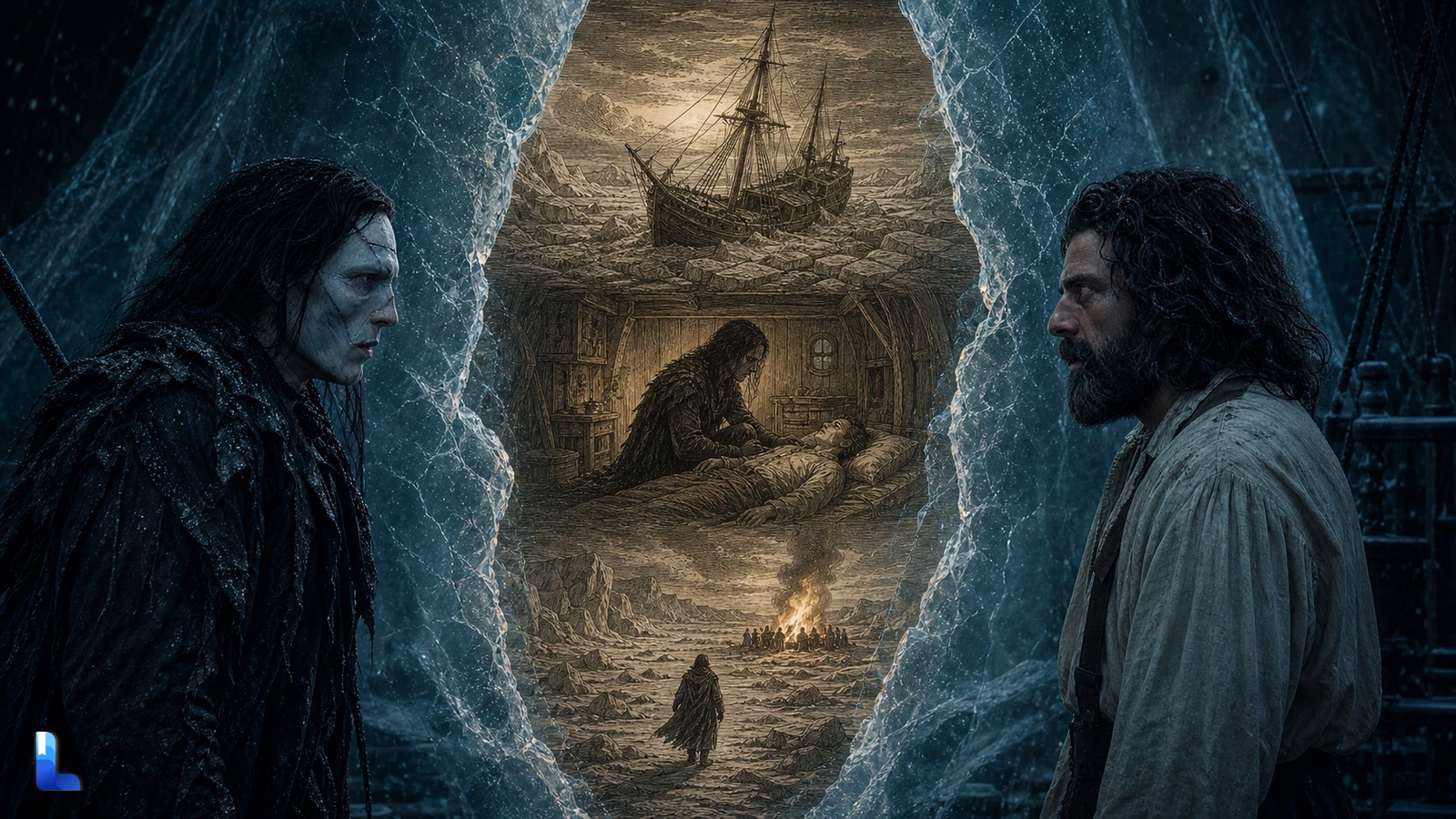
Guillermo del Toro changes the ending of Frankenstein from mutual ruin to forgiveness and survival. In Mary Shelley’s novel, Victor dies without reconciling with the Creature, who declares that he will destroy himself by fire. In the 2025 film, Victor asks forgiveness, the Creature grants it, frees the trapped ship, and turns toward the Arctic sun.
That is not only a happier ending. It gives the story a different answer about guilt. Shelley lets remorse arrive too late to repair what Victor and the Creature have done. Del Toro lets recognition end the violence and gives the surviving son a chance to live differently from his father.
Full spoilers follow for the film and Mary Shelley’s novel. If you have not read the book, begin with our new reader’s guide to Frankenstein.
Fire in the novel, sunlight in the film
The final movement returns to Robert Walton’s Arctic expedition. Victor has pursued the Creature north, lost the last of his strength, and been taken aboard Walton’s ship. The crew is trapped by ice and asks Walton to turn back if they can escape.
Victor gives Walton conflicting advice. He has spent his story warning against ambition, yet he urges the sailors not to abandon glory because they are afraid. Near death, he offers a quieter instruction:
“Seek happiness in tranquillity, and avoid ambition, even if it be only the apparently innocent one of distinguishing yourself in science and discoveries.”
Victor dies while still wishing for the Creature’s destruction. He never admits his failure to the Creature, asks for forgiveness, or accepts him as a son.
The Creature arrives after Victor’s death. Walton finds him leaning over the body and grieving. He does not claim innocence. He says that revenge made his suffering worse and that Victor’s death has removed the last person with whom he had any bond.
“Farewell, Frankenstein!”
He then announces his intended end:
“I shall ascend my funeral pile triumphantly”
Shelley does not show the fire or confirm his death. The Creature leaves the ship and disappears into the darkness. His final speech promises self destruction, but the last image keeps his fate just beyond Walton’s sight.
There is remorse in this ending, but no repair. William, Justine, Henry, Elizabeth, and Victor are dead. The Creature understands the horror of his revenge only after nothing can be restored. Walton is the one person who can still change course. He listens to his crew and chooses human lives over the dream of reaching the pole.
The film lets Victor and the Creature meet.
Del Toro brings creator and creation together before Victor dies. The Creature’s account forces Victor to see his experiment as a neglected child rather than a failed object. Victor accepts that he has acted as a cruel father and asks the Creature to forgive him.
The Creature does. He says Victor’s name, and Victor dies in peace rather than in a final demand for revenge. Netflix’s official ending account describes forgiveness as the act through which the Creature recognizes both Victor’s harm and the wounded child Victor once was.
The Creature then leaves Captain Anderson’s cabin. Anderson allows him to go, and the Creature frees the ship from the ice. Anderson orders the crew to return home. The final image shows the Creature facing the Arctic sun with his arms open.
The novel ends with a promised fire that would erase the Creature. The film ends with sunlight falling on a body that cannot die.
Four changes create the new ending
The ending works because del Toro has changed more than the last scene. Four choices prepare his version of the Creature for survival.
Victor admits what he did.
Shelley’s Victor can describe his errors, but his insight remains unstable. He warns Walton about ambition and then urges Walton’s frightened crew to continue. He pities some of the people harmed by his silence, but he keeps presenting the Creature as an enemy who must be destroyed.
The film gives Victor a clearer admission. Hearing the Creature’s account produces an answer rather than another argument. Victor sees the Creature as his son and understands abandonment as his central wrong.
This makes forgiveness possible, but it also removes some of Shelley’s discomfort. The novel leaves us with a man who can tell a persuasive story about responsibility without fully accepting it. The film lets him understand himself before death.
The Creature forgives Victor face to face.
In the book, the Creature mourns over a body. Victor cannot hear his regret, challenge it, or answer it. Their final speeches pass one another.
The film turns those separate speeches into a conversation. Recognition moves in both directions. Victor calls the Creature his son. The Creature sees that Victor inherited pain from his own father and chooses not to continue it.
Del Toro has described his adaptation as a personal story about fathers and sons. He told Netflix that he wanted to return Shelley’s story in a different emotional key. The film’s ending supplies that key. A son becomes different from his father by understanding him without excusing what he did.
The Creature cannot choose death.
Shelley’s Creature expects the funeral fire to end his pain and remove his body from the world. The film makes him capable of healing from wounds that should kill him. Death is no longer available as an answer.
Immortality changes the final decision. The Creature cannot prove his remorse through self destruction. He has to decide what to do with a life that continues after revenge.
This makes the sunrise more than a beautiful image. Victor once taught the newborn Creature to feel the sun. At the end, the Creature keeps that memory without keeping Victor’s hatred.
Mercy becomes an action.
The Creature does not leave the ship after making a speech. He frees the people who attacked him. Captain Anderson responds by abandoning the expedition and taking his crew home.
Shelley gives the saving decision to Walton. Del Toro divides it between Anderson and the Creature. The captain turns back, and the Creature makes that return possible.
Forgiveness therefore affects people beyond Victor. It stops the pursuit and saves the crew. The film makes its moral visible through an action that the novel’s Creature never performs.
The film also changes who carries the guilt
The novel’s Creature begins with sympathy and becomes a deliberate killer. He murders the child William, places evidence on Justine, kills Henry, and murders Elizabeth after Victor destroys the unfinished companion. Victor’s abandonment helps explain the Creature’s anger. It does not make those deaths accidental.
Del Toro keeps the Creature closer to innocence. The film shifts several deaths away from his deliberate revenge and places more direct blame on Victor. Time notes that the screen Creature targets Victor rather than extending his revenge across Victor’s family. Forbes argues that this choice makes the Creature easier to love but reduces the novel’s moral ambiguity.
The changed ending depends on that changed guilt. Forgiveness would feel different if the film’s Creature had knowingly murdered a child, framed an innocent woman, and killed Victor’s closest friend and bride. Del Toro has built a Creature who can reach the final cabin with far less to confess.
Victor changes in the other direction. The film gives him an abusive father and makes his own cruelty toward the Creature more direct. His violence becomes part of a chain passed from father to son. The last conversation is designed to break that chain.
Shelley refuses that clean answer. She does not divide the story into an innocent Creature and a guilty creator. Victor makes life and abandons it. The Creature suffers because of that abandonment and then chooses to make other people suffer. Each uses the other’s cruelty to explain his own.
Their resemblance grows during the pursuit. Both are isolated. Both speak as if no one has suffered as much as they have. Both make revenge the last purpose left in life. The Creature’s final remorse shows that he understands this resemblance, but understanding comes after the damage is complete.
The novel can still move a reader to pity him. Pity does not settle the judgment. Shelley leaves the Creature mourning, guilty, eloquent, and alone.
Del Toro settles more. Victor is the failed father. The Creature is the injured son who remains capable of grace. The film asks whether pain must pass from one generation to the next, then answers no.
Does the hopeful ending simplify the story?
It simplifies one part and deepens another.
The film loses some of the novel’s hardest moral tension. Shelley makes the Creature both a victim and a murderer. His final sorrow cannot return the dead or prove that the planned fire will happen. Del Toro protects more of the Creature’s innocence and gives Victor a complete moment of self knowledge. The lines of blame become easier to see.
The film gains a sustained argument about inherited harm. Victor repeats the cruelty he experienced from his father. The Creature sees that history and refuses to repeat it. Immortality then makes living well, not dying dramatically, the difficult task.
Not every viewer found the reconciliation convincing. In ELLE’s comparison, both editors understand the intended forgiveness but question whether the final cabin scene has earned it. That objection points to the risk in del Toro’s change. A hopeful ending needs the audience to believe that one honest exchange can stop years of violence.
The ending is still consistent with the film del Toro made. His Creature learns through the care of others, remains capable of tenderness, and cannot escape life through death. The final act asks him to use those qualities when hatred would be easier.
The two endings are easiest to compare side by side.
| Final choice | Shelley’s 1831 novel | Del Toro’s 2025 film |
|---|---|---|
| Victor’s last relation to the Creature | Still wants him destroyed | Accepts him as a son and asks forgiveness |
| The Creature’s response | Mourns after Victor can no longer hear him | Forgives Victor face to face |
| The Creature’s fate | Promises a funeral fire and disappears | Cannot die and chooses to continue living |
| The ship | Walton agrees to turn back | Anderson turns back after the Creature frees the ship |
| Final image | The Creature vanishes into darkness | The Creature opens his arms to sunlight |
| Moral result | Remorse cannot repair revenge | Recognition can interrupt inherited harm |
Calling one ending faithful and the other unfaithful does not say enough. Del Toro keeps Shelley’s Arctic frame and the bond between creator and creation. He changes what that bond can achieve. Shelley allows it to produce only a final lament. Del Toro allows it to produce forgiveness, mercy, and another morning.
The novel quotations and chapter details in this comparison come from the exact 1831 edition distributed in LitaBook. Read the guide first, then return to the final pages and decide whether the Creature should walk toward fire or sunlight.