
Frankenstein for New Readers: Difficulty and Reading Time
Mary Shelley’s Frankenstein is moderately difficult and takes most readers five to seven hours. Learn how to follow its language and nested narrators.
Frankenstein is moderately difficult for a new reader. Mary Shelley’s formal sentences and nested narrators need patience, but the plot and character list are manageable. LitaBook’s 1831 edition contains 78,047 words and has an estimated reading time of 287 minutes, or 4 hours 47 minutes. Most readers should allow 5~7 hours if they pause over the Creature’s speeches.
The familiar laboratory scene occupies only a small part of the novel. Most of the book is about what Victor does after he creates life, what the Creature learns after Victor abandons him, and how both of them try to make another man accept their version of events.
The book is not the movie in your head
Readers often arrive with a complete set of images from later adaptations. A square green monster rises from a table. Bolts stick out of his neck. An assistant waits nearby. The Creature speaks in broken sounds, and the name Frankenstein belongs to him.
Shelley’s novel gives you something else. Victor Frankenstein is the young scientist. The Creature has no personal name. He is unusually tall and frightening to look at, but he is also quick, observant, and capable of long arguments. He learns language by listening to a family through a wall. He reads Paradise Lost, Plutarch, and Goethe. He can describe his loneliness with more force than Victor can describe his remorse.
The popular image is not useless. It shows how thoroughly the story escaped its book. But it can hide the reason the novel still feels alive. Victor does not lose control of a mindless machine. He refuses responsibility for a person who can judge him.
How to find your way through the novel
The opening letters may feel like a delay if you expect Victor to enter at once. They are the frame that makes the novel work.
Robert Walton is leading an Arctic expedition. He writes home to his sister, Margaret Saville, and tells her about his ambition, his loneliness, and the strange man his crew rescues from the ice. That man is Victor. Walton then records Victor’s account. Inside Victor’s account, the Creature asks to be heard and tells his own life.
The movement looks like this:
Walton writes to his sister → Victor speaks to Walton → the Creature speaks to Victor → Victor finishes his account → Walton writes again.
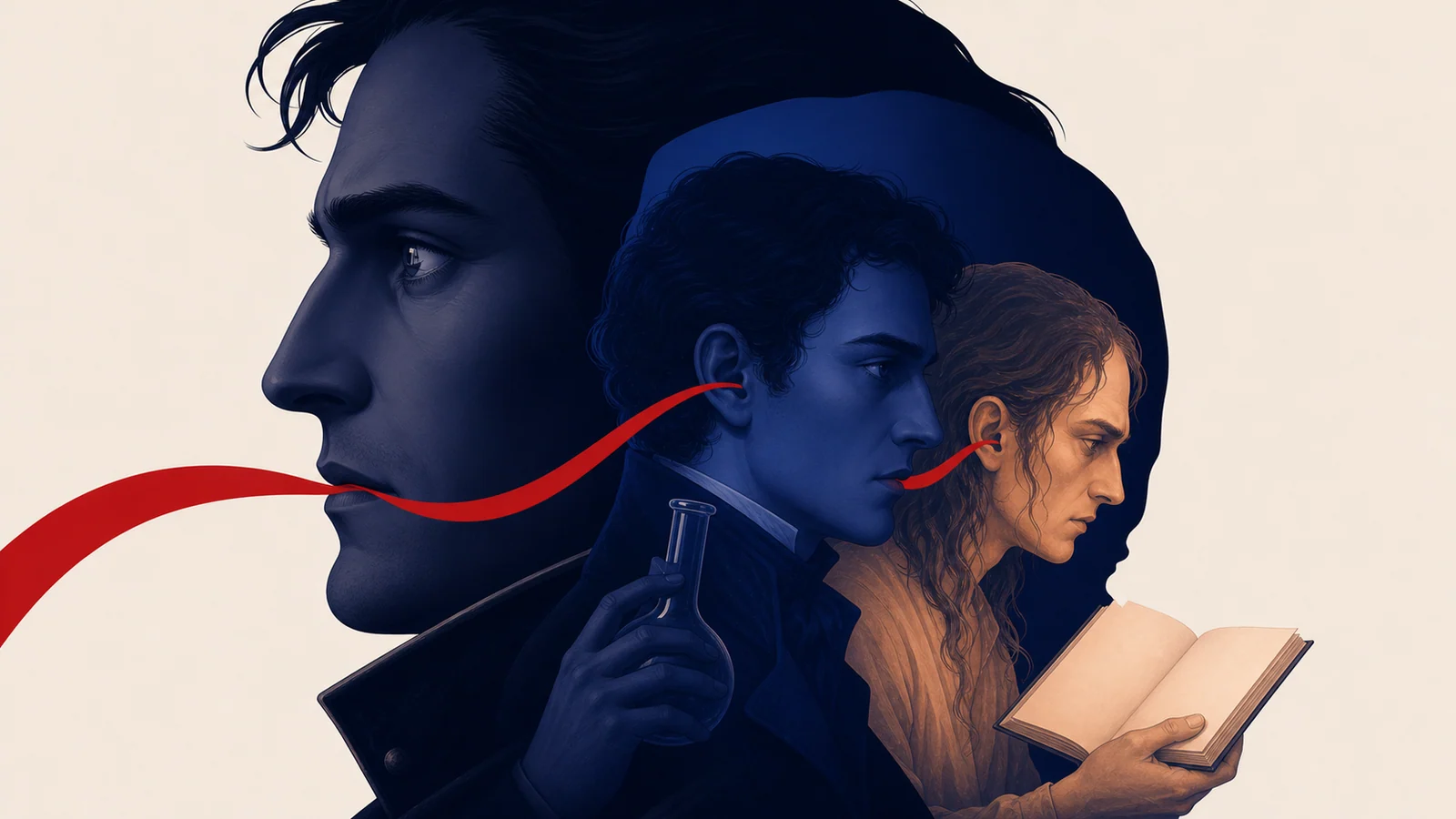
These layers do more than arrange the plot. Walton admires Victor before he knows the full cost of Victor’s ambition. Victor wants Walton to treat his life as a warning, but he also wants to appear exceptional. The Creature asks Victor for justice while admitting that misery has changed him.
You do not have to decide which man is telling the truth and which man is lying. Their accounts overlap. Pay attention to what each speaker explains clearly, what he excuses, and what another person cannot confirm.
Is Frankenstein hard to read?
Frankenstein is moderately difficult, but it gets easier after the opening letters. Shelley’s sentences are formal and often long. Characters describe feelings at length, and Victor can spend a page moving from hope to despair without leaving a room. The prose is not Old English. It is nineteenth century English written by people who treat a moral argument as part of the action.
The opening can feel slow because Walton is still preparing the expedition and imagining what success will mean. Once he rescues Victor, the story gains a clear direction. Victor’s childhood, education, and experiment lead toward the creation scene in Chapter 5. The Creature’s account in Chapters 11~16 is often easier because he notices the world one object, sound, and human action at a time.
Names are unlikely to cause trouble. Keep Walton, Victor, Elizabeth, Henry Clerval, and the De Lacey family in mind. The harder task is following responsibility. Victor often knows that his silence may hurt someone and still decides that speaking would be too difficult or unbelievable.
How long does Frankenstein take to read?
Most readers should allow 5~7 hours. LitaBook’s edition contains 78,047 words, including its introduction and other edition material. The app estimate is 287 minutes, or 4 hours 47 minutes. At 250 words per minute, the same word count takes about 5 hours 12 minutes. At 200 words per minute, it takes about 6 hours 30 minutes.
Page counts are less useful. Type size, notes, illustrations, and whether an edition prints the 1818 or 1831 text can change the number of pages. A five to seven hour range is more honest for most readers. Add time if you want to pause over the Creature’s speeches or compare the two editions.
The story has better stopping points than a fixed seven day schedule:
- Stop after Chapter 5. Victor has completed the act he spent years pursuing. His first response tells you what kind of creator he will be.
- Stop after Chapter 10. Victor meets the Creature again and finally agrees to listen. The next chapter changes the narrator and the reader’s sympathy.
- Stop after Chapter 17. The Creature has finished his history and made a request. Decide what Victor owes him before reading Victor’s answer in action.
- Stop after Chapter 21. The cost of their broken agreement is now visible. Chapters 22~24 form the final pursuit and return to the Arctic frame.
Read one section at a time or divide each section across several days. The pauses follow changes in who speaks and what Victor must decide. They will stay useful even if your available time changes during the week.
Four lines worth marking
Famous quotations from Frankenstein are useful when they remain attached to the person and decision that produced them. These four lines can guide a first reading.
Victor warns Walton about knowledge.
“Learn from me, if not by my precepts, at least by my example, how dangerous is the acquirement of knowledge, and how much happier that man is who believes his native town to be the world, than he who aspires to become greater than his nature will allow.”
Victor says this while telling the story of his studies. The warning sounds clear, but Victor remains proud of reaching knowledge that no one else possessed. Watch the gap between the lesson he states and the admiration he still wants.
The Creature names the relationship Victor denied.
“I ought to be thy Adam”
The Creature compares himself with both Adam and the fallen angel in Paradise Lost. He was made without parents, companions, or a place in society. The line turns creation into a relationship. Victor wanted the power of a creator without accepting a creator’s duties.
The Creature explains what changed him.
“I was benevolent and good; misery made me a fiend.”
This is an explanation, not proof of innocence. The Creature begins with kindness and a desire to join other people. Repeated rejection changes what he chooses to do. Shelley still makes him responsible for those choices.
Love becomes a threat.
“if I cannot inspire love, I will cause fear”
The sentence is frightening because the Creature understands both possibilities. He does not begin as a force that can only destroy. He decides that fear can give him power when affection has failed.
Read for care, not only ambition
Victor’s experiment raises an obvious question about dangerous knowledge. The novel keeps asking a more practical one after the experiment succeeds. What does a maker owe the life he has made?
Victor judges the Creature by his appearance before the Creature has spoken or harmed anyone. He leaves. Later, he treats secrecy as protection even when other people face the results. His worst choices are often refusals to care, explain, or remain present.
The Creature also makes choices that cannot be blamed entirely on Victor. He learns sympathy by watching the De Laceys, then learns how much harm he can cause. His suffering helps us understand his anger. It does not make each act of revenge just.
This is why the nested narrators matter. Victor and the Creature can each describe himself as the injured party. Walton has to hear the warning and decide whether his own ambition is worth other people’s lives. The reader has to make the same judgment without a neutral narrator to settle it.
LitaBook carries the 1831 text.
Mary Shelley first published Frankenstein anonymously in 1818 and revised it for a new edition in 1831. The versions differ in wording, family history, references, and the way they frame Victor’s freedom and fate. Romantic Circles documents the revised text and its new introduction. You do not need to compare the editions before a first reading.
LitaBook distributes the revised 1831 text, with Shelley’s introduction, Walton’s four opening letters, Chapters I~XXIV, and Walton’s continuation at the end. The edition is based on the text prepared by Standard Ebooks. Its word count, chapter labels, and quotations are the basis of this guide.
If Guillermo del Toro’s film brought you to the novel, the largest surprise waits at the end. Our comparison with full spoilers explains how del Toro changes Frankenstein’s ending and its moral. Read Shelley first if you want the last encounter to arrive without warning.