
How Long Does Dracula Take to Read? A Guide to All 27 Chapters
Dracula takes about 10 to 13.5 hours to read. See the exact time for Lita Book's complete edition and follow a practical 12 session plan.
Dracula takes about 10~13.5 hours to read. Lita Book’s complete English edition contains 160,979 words across 27 chapters. The app estimates 592 minutes, or 9 hours 52 minutes. At a slower pace of 200 words per minute, the same text takes about 13 hours 25 minutes.
The novel is moderately difficult. Its language is often direct, but the story moves between diaries, letters, telegrams, newspaper reports, and a ship’s log. The most useful reading habit is to check the date and writer at the start of each document.
How long does Dracula take to read?
Your time depends on reading speed and whether you pause over dialect, unfamiliar places, or Van Helsing’s speeches.
| Reading pace | Estimated time |
|---|---|
| Lita Book estimate | 9 hours 52 minutes |
| 250 words per minute | about 10 hours 44 minutes |
| 200 words per minute | about 13 hours 25 minutes |
Plan for 10~13.5 hours if you are reading the complete novel. A short edition or graded reader can be much faster because it may remove passages or rewrite the language. Page counts are less reliable because type size, notes, and illustrations vary between editions.
Standard Ebooks lists its text at 161,105 words and 9 hours 46 minutes. That is close to the Lita Book edition. The small difference comes from edition material and text production choices.
Is Dracula hard to read?
The first four chapters are easy to follow. Jonathan Harker travels to Transylvania, meets Count Dracula, and realizes that he is a prisoner. One person records most of the action, and the castle gives every scene a clear location.
Chapter 5 changes the reading experience. Jonathan disappears from the page. Mina Murray and Lucy Westenra exchange letters, and Dr. Seward begins a phonograph diary. Later chapters add telegrams, newspaper reports, memoranda, and private journals. The plot still moves forward, but the person holding the evidence keeps changing.
Three parts may slow a new reader:
- The speaker can change several times in one chapter. Read each document heading before continuing.
- A Whitby sailor speaks in dialect, and Van Helsing’s English has an unusual rhythm. Focus on the warning or decision inside the speech.
- The middle of the novel repeats medical visits, blood loss, sleep, and failed protections. Track what was added, who removed it, and what changed by morning.
The dates, names, and locations are a navigation system. You do not need to make a separate character chart if you keep those headings in view.
Read each document as evidence
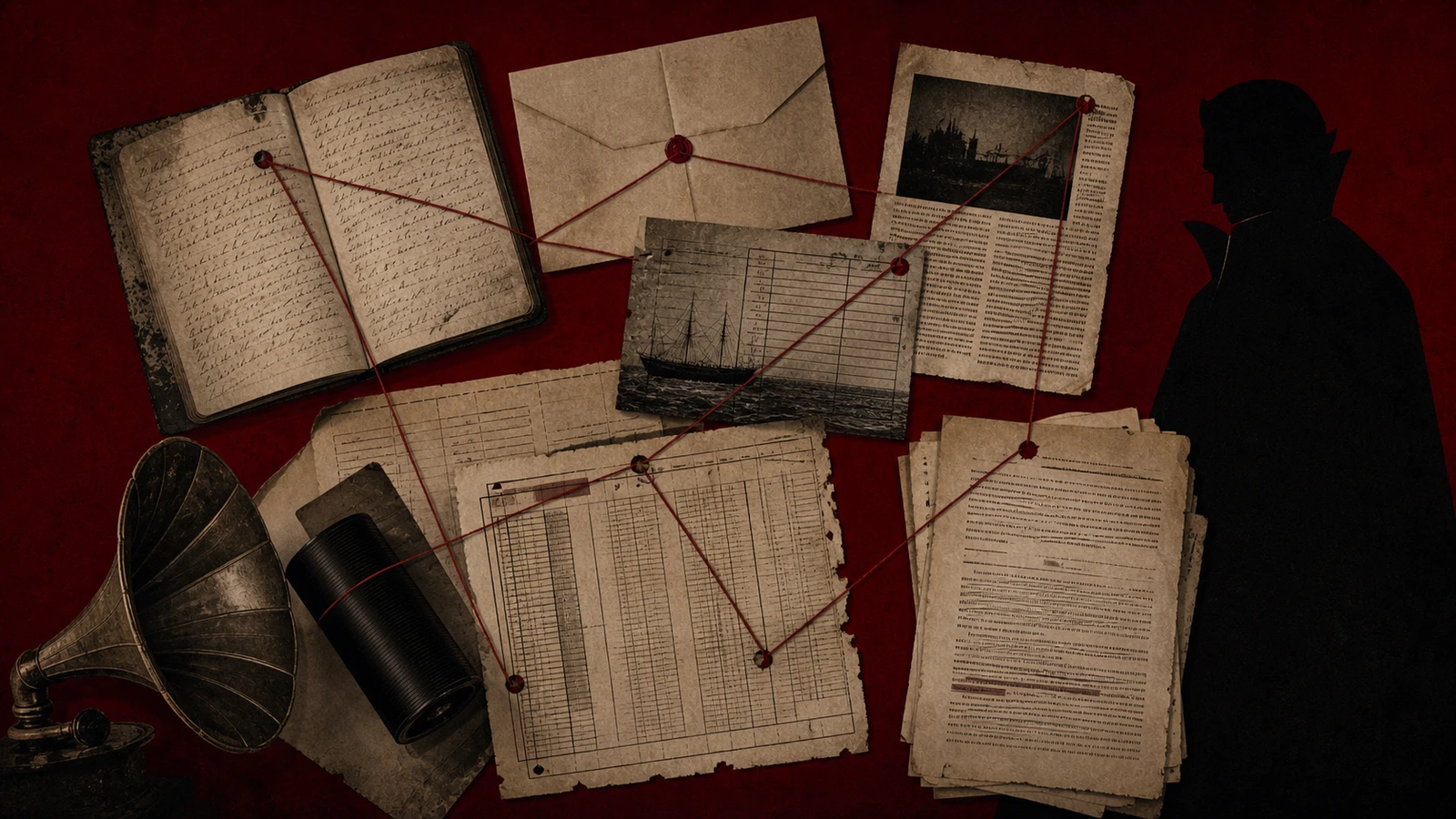
The short Preface explains that the records have been placed in sequence. Each writer knows only what was available at the time. No neutral narrator steps in to explain Dracula’s plan.
At the start of an entry, note three facts:
- When was it written?
- Who made the record?
- What does that person know at this point?
A newspaper report may confirm something a diary writer dismissed. A ship’s log can preserve an attack that no passenger survived to explain. A telegram can reveal whether a warning arrived in time.
Mina eventually types, copies, and arranges the group’s documents. Her work turns private experiences into a shared case. Dracula never writes an entry of his own. The group reconstructs his movements from property records, injuries, boxes, routes, and witness accounts.
The 27 chapters form four movements
Chapters 1~4: The castle. Jonathan enters Dracula’s world, learns that ordinary rules do not apply, and tries to escape.
Chapters 5~9: The danger reaches England. The book introduces Mina, Lucy, Seward, and Renfield. The Demeter carries the threat to Whitby.
Chapters 10~18: The witnesses compare evidence. Lucy’s illness forces Van Helsing to test an explanation that sounds impossible. Mina and Jonathan’s documents connect the danger in Transylvania to events in England.
Chapters 19~27: The investigation becomes a hunt. The group traces Dracula through houses and boxes. When Mina is drawn into the danger, their records become both a weapon and a risk.
These are practical stopping points, not formal parts printed in the EPUB.
A 12 session plan for the complete novel
This plan covers every chapter in Lita Book’s EPUB. The estimates add up to the app’s 592 minute total.
- Chapters 1~3, about 62 minutes. Follow Jonathan from his journey east to the moment he accepts that the castle is a prison.
- Chapters 4~6, about 56 minutes. Finish the castle record, then meet Mina, Lucy, Seward, and Renfield.
- Chapters 7~8, about 44 minutes. Read the newspaper report and the Demeter log as one arrival story.
- Chapters 9~10, about 44 minutes. Mina finds Jonathan while Seward and Van Helsing begin treating Lucy.
- Chapters 11~12, about 46 minutes. Track each protection around Lucy and how it fails.
- Chapters 13~14, about 48 minutes. Mina’s copy of Jonathan’s journal gives Van Helsing a second body of evidence.
- Chapters 15~17, about 59 minutes. The separate records and their writers begin to come together.
- Chapters 18~19, about 47 minutes. The group studies the full collection and enters Carfax.
- Chapters 20~21, about 45 minutes. Jonathan traces Dracula’s boxes while Renfield tries to communicate an urgent danger.
- Chapters 22~23, about 41 minutes. The group searches Dracula’s London properties and confronts him.
- Chapters 24~25, about 46 minutes. Dracula retreats toward Transylvania, and the group works out his route.
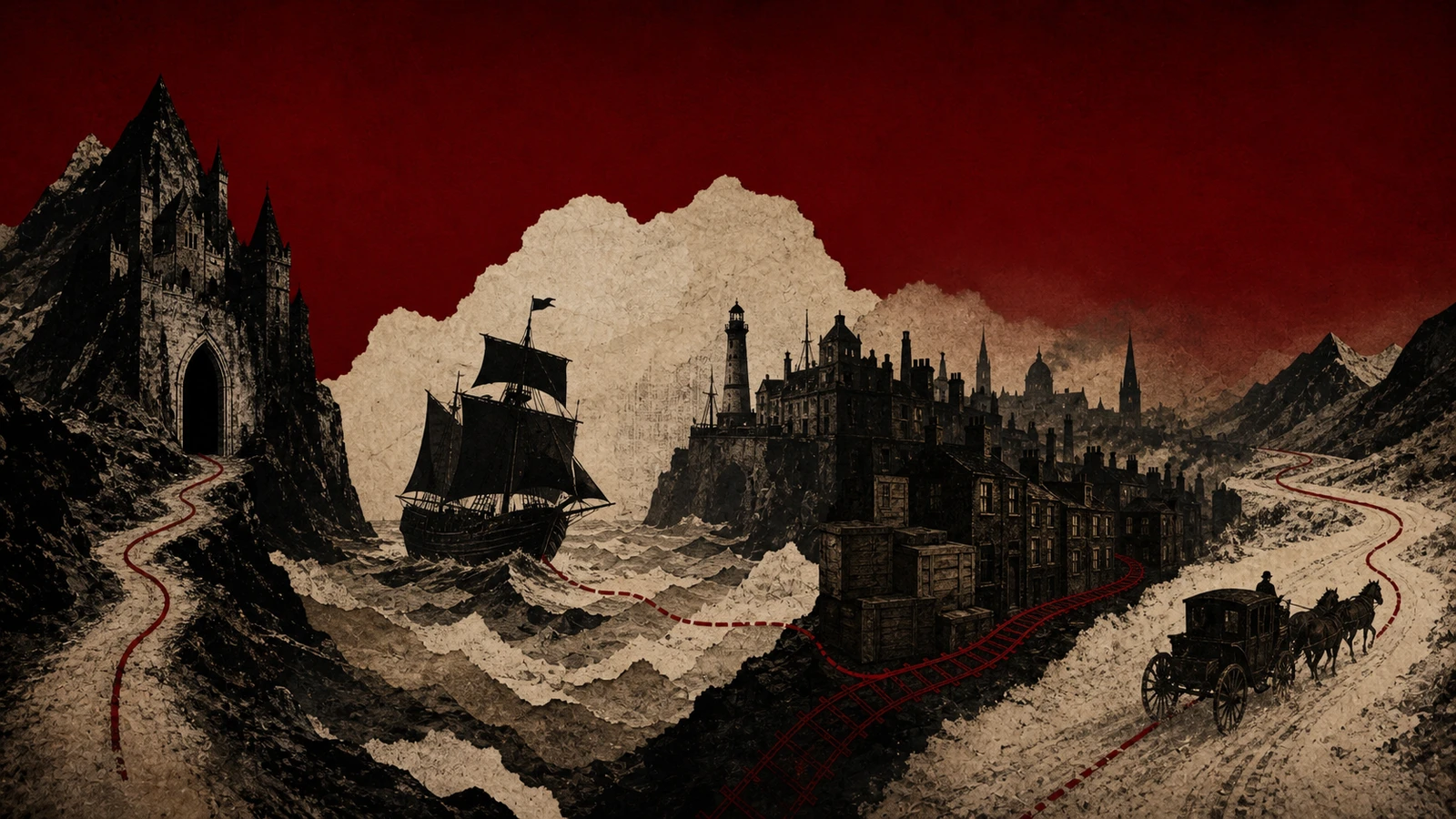
- Chapters 26~27, about 54 minutes. The pursuit splits across river, road, and rail before converging near the castle.
If an hour is too long, split a session at a document break. Restarting at a dated heading makes it easier to recover the speaker, location, and known facts.
Where do readers usually slow down?
Chapter 5 is the first likely break. Jonathan vanishes just after the castle reaches its most dangerous point. The new letters do not return to him immediately. They introduce the people and habits that Dracula’s arrival will disrupt.
The Whitby chapters can feel crowded. Keep four movements in view. Mina watches Lucy, a storm drives a ship into the harbor, a large dog escapes from the wreck, and Lucy’s sleepwalking becomes more dangerous. The newspaper cutting and ship’s log describe the same arrival from different angles.
Chapters 10~14 repeat treatments and failed safeguards. Read them as a record of what Van Helsing understands before the others are willing to accept it.
The final chase has many place names and travel updates. Follow the transport problem. Dracula is being carried toward his castle, and the group splits up to intercept his route.
What should you know before starting?
Do I need to know vampire rules first?
No. The characters begin with partial folklore, medical explanations, and disbelief. Discovering the rules with them preserves the mystery.
Is Count Dracula the narrator?
No. Jonathan records Dracula’s speech, but the Count contributes no diary, letter, or memorandum. Every account of him comes from a witness, victim, investigator, or document.
Is “Dracula’s Guest” one of the 27 chapters?
No. Lita Book’s edition contains the Preface, Chapters I~XXVII, and a final Note. “Dracula’s Guest” is a separate work and is not included in this plan.
Which is harder, Dracula or Frankenstein?
Dracula is more than twice as long in the Lita Book editions, but its records often describe immediate action. Frankenstein is shorter, yet its formal arguments and stories inside stories can feel denser. Readers who dislike changing speakers may find Dracula harder. Readers slowed by philosophical language may find Frankenstein harder.
The figures and chapter order in this guide come from Lita Book’s distributed English EPUB of Dracula, book ID 345. You can read it in Lita Book’s classics collection.